floating roots exhibition introduction
floating roots, pieces of home, the return
KCCA – Gulangyu Center for Contemporary Art – Red Hall
Xiamen, China
November 2025 to April 2026

Growing up between English and Chinese culture has had a profound effect on who I am and what I do. Since I can remember, I have been driven by questions about what it means to connect and to belong. A journey of enquiry where one thing leads to another and yet all things somehow relate. This past November, a notable opportunity arose. I was invited to exhibit my work in China.

My father was part of a generation of young Chinese from well situated families who were sent abroad to be educated, with the vision they would return to contribute what they had learned to the homeland.


In 1949, due to the political unrest in China and his marriage to my British mother, my father was advised by his family to remain in the West. He did not return until 32 years later. He carried a deep sense of sadness and guilt, to not have been able to return sooner. I grew up with the hidden weight of his longing and was the only one of his immediate family to meet his parents.
My first return to Asia was when I was 17. I went for a year to Taiwan to study Chinese and to stay with my grandparents, my aunt and uncle, and their four children. It was the first time I met my relatives and a remarkable and complex discovery for all of us.
Later in 2002, I returned with my father to his birthplace in Gulangyu, also known as Kulangsu, a small island off the coast of Xiamen in the Fujian province of China. It was a profound experience. The house of my great grandfather, where my father was born was still standing, but in a state of abandonment and ruin. For me it was none the less an anchoring of my sense of belonging through which many aspects of my childhood became clear. Both visits had an impact on my work. Once again, it was clear to me that by no incidental means had I become an artist. Art was my means to navigate the broad spectrum of differences in my life.

Early in 2025, the Chinese curator Li Zhenhua, with whom I collaborated for my exhibition On the Edge of Time in Milan, (Villa Arconati FAR, Milan, 2022), introduced me to Ethan Chen and Li Li, from the Kulangsu Center for Contemporary Art (KCCA). I was invited to exhibit in their museum with Guo Guozhu, a local photographer from Xiamen.
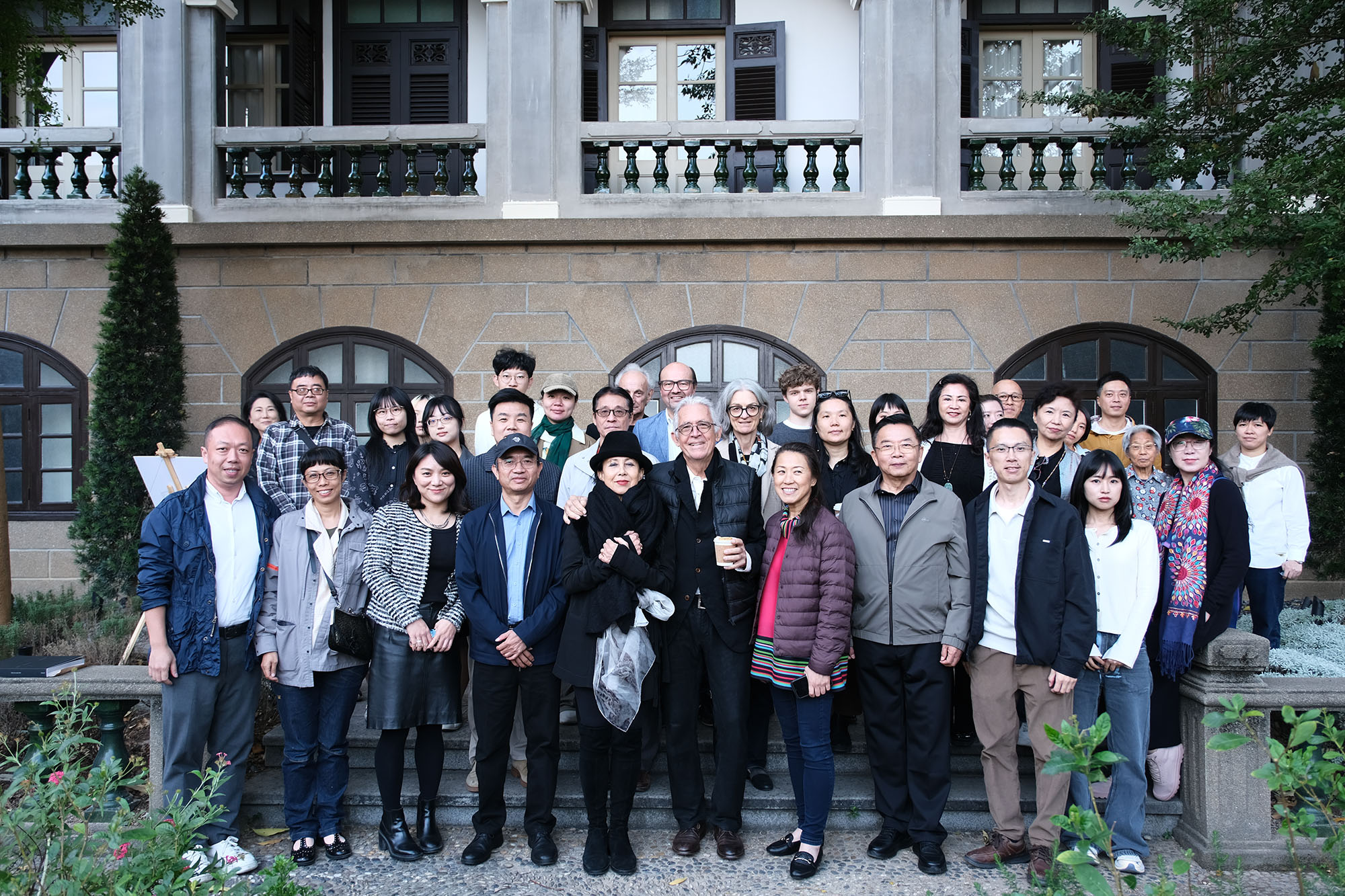

The Lin Mansion, in the meantime, had been renovated as a boutique hotel and, in 2010, was designated a UNESCO World Heritage Site. I was also invited to create an installation for the Lin’s Mansion Art Space. Returning not only to exhibit my work in Gulangyu but also in the former house of my great-grandfather was a remarkable. What had been mostly rooted in my imagination suddenly became concrete—a turning inside out of sorts.
What constitutes my personal story of cultural diversity is today a widespread theme. China itself is deeply engaged in a process of rediscovery of its own cultural heritage. To be received by a Chinese audience that asks similar questions to my own extended my project beyond the personal. The local people were inspired by my life long enquiry to return to my roots, not only with a view to the past, but also in context with the present and the future.
The question arose how I could create an exhibition on the other side of the world while minimizing shipping. The cost and waste of art packaging is immense. For the China project, I envisioned carrying a body of work myself: a symbolic return transforming the imagined into the tangible. Searching for a form through which my paintings and installation work could be carried easily, silk came to my mind.
My relation to silk began when I was a small girl. Periodically, packages would arrive from my Chinese family. Amongst the assortment of sweets, Chinese medicine, salted plums and dried mushroom and shredded pork powder, there would sometimes be embroidered silk slippers for me. Although the slippers were often too small, I loved them. The attention to detail, the balance of colour, the flowers, the insects.


In 2008, I started experimenting with printing my paintings on silk to make garments. The idea of wrapping oneself in a painting interested me. Particularly in a time of increasing anonymity towards what we put on our bodies. I envisioned a multi-purpose artefact that one could wear, hang, cover, bandage, bundle, and carry with you wherever you go. Something familiar amidst the turnover of goods we consume.
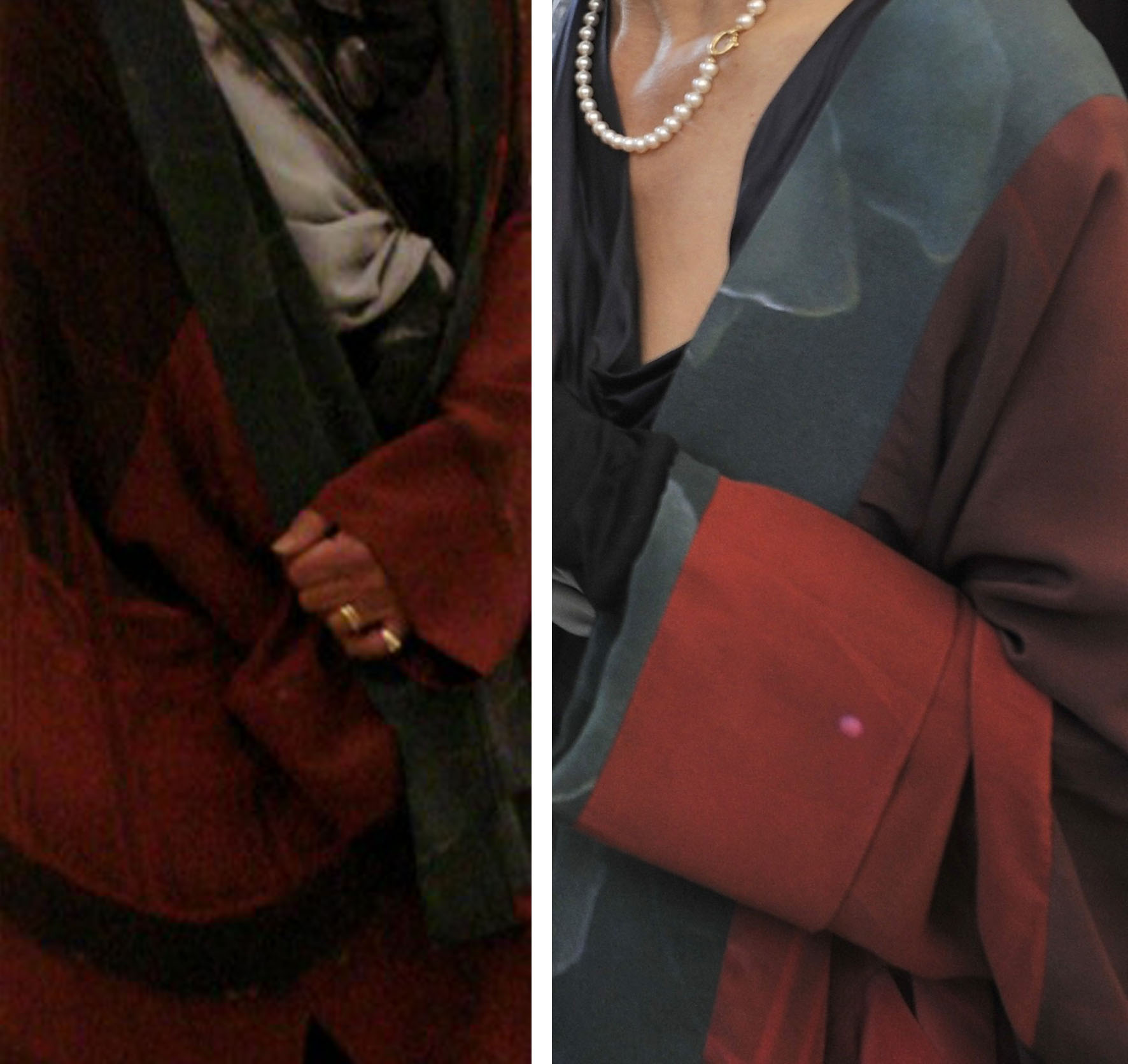
Another aspect of silk that connected to the China project was the historical connection between East and West. During the Song and Yuan dynasties, both Xiamen and Quanzhou were significant ports on the Maritime Silk Road, where their freight ultimately reached Italy.
To re-route and be travelling back east with my cedar silks seemed to mark the times. The 350 meters of silk I used weighed less than 40 kilos and fit into two suitcases, which travelled with me. The suitcase carried its own metaphor: an image of transience and change, symbolic of my life. Using a selection of my oil paintings printed on various weights of silk, I began shaping the return to my Chinese roots.
Transforming my enquiries as a painter into three-dimensional compositions, where the lightness and transparency of silk was both interesting and challenging. So delicate as it appears, silk is also tough and, above all, difficult to control. The folding, knotting, cutting, and sewing was surprisingly demanding. The hours of ironing – humbling.
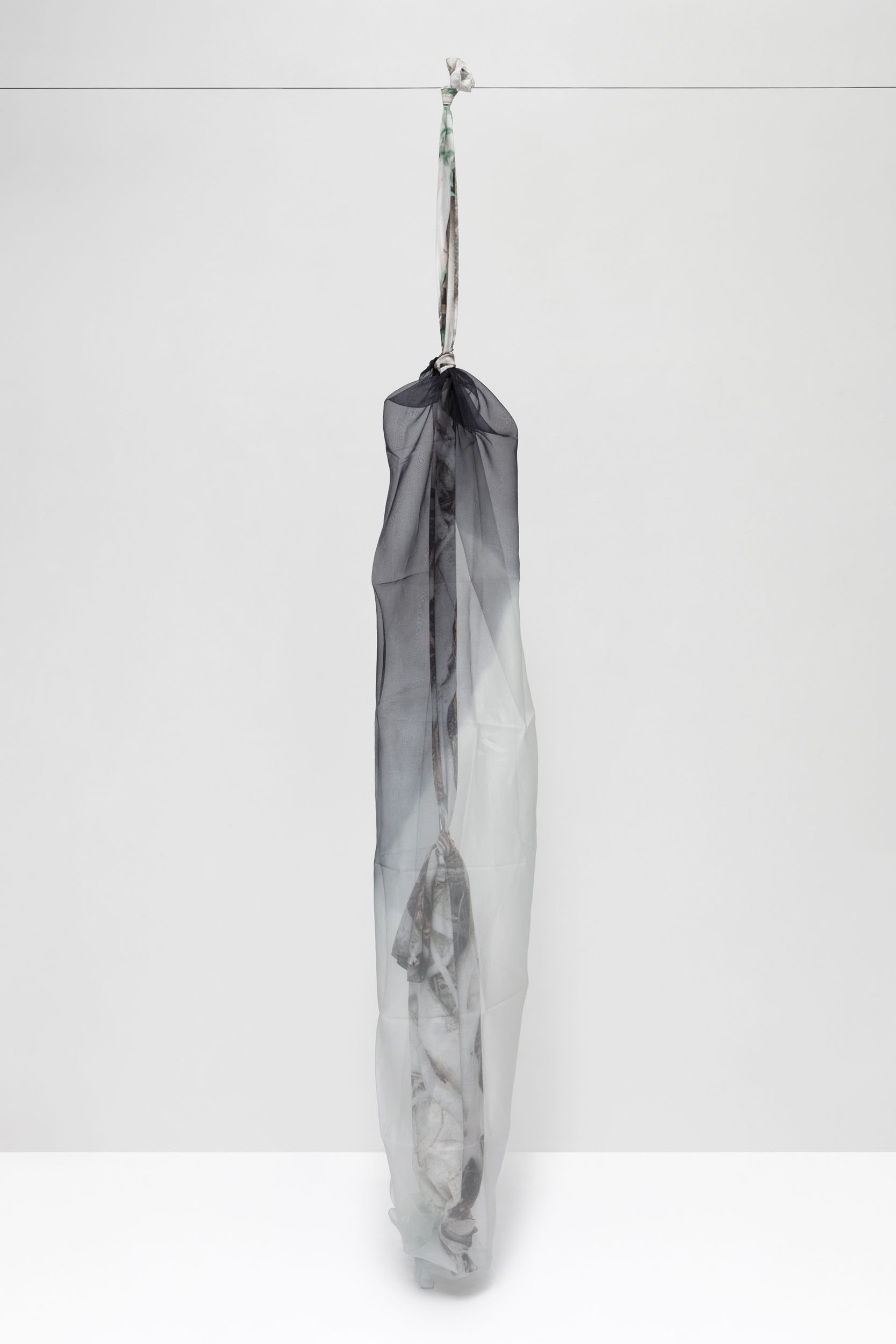
Coming to life from the folds of this ambiguous material, the project became an almost cinematic sculpture. Then, to unpeg, refold and repack it into the suitcases – was like the passing of a dream. And yet it leaves traces. I am not the same person since this took place. Perhaps life is
always like this.